Available width for composite beams
Available width defines the region of the slab that can be structurally attributed to the beam for composite action. This is essential for accurate structural design of composite beams to ensure only the slab area that can be mobilised is used.
Note: Available width is different from effective width. The latter is the portion of slab that is assumed to participate effectively in resisting bending, calculated to model shear-lag effects. The effective width is generally smaller than the available width, so the former acts as an upper bound. That is, from the available width, only a portion can be effectively mobilised: this portion is the effective width.
GSA calculates available widths for composite beams accounting for slab geometry, voids and the presence of other beams. These factors may result in local geometric reductions, as explained in subsequent sections.
GSA-calculated available widths are then used as inputs when generating Compos files via the GSA-Compos integration. Then, within Compos, the effective width is calculated.
Simple base case
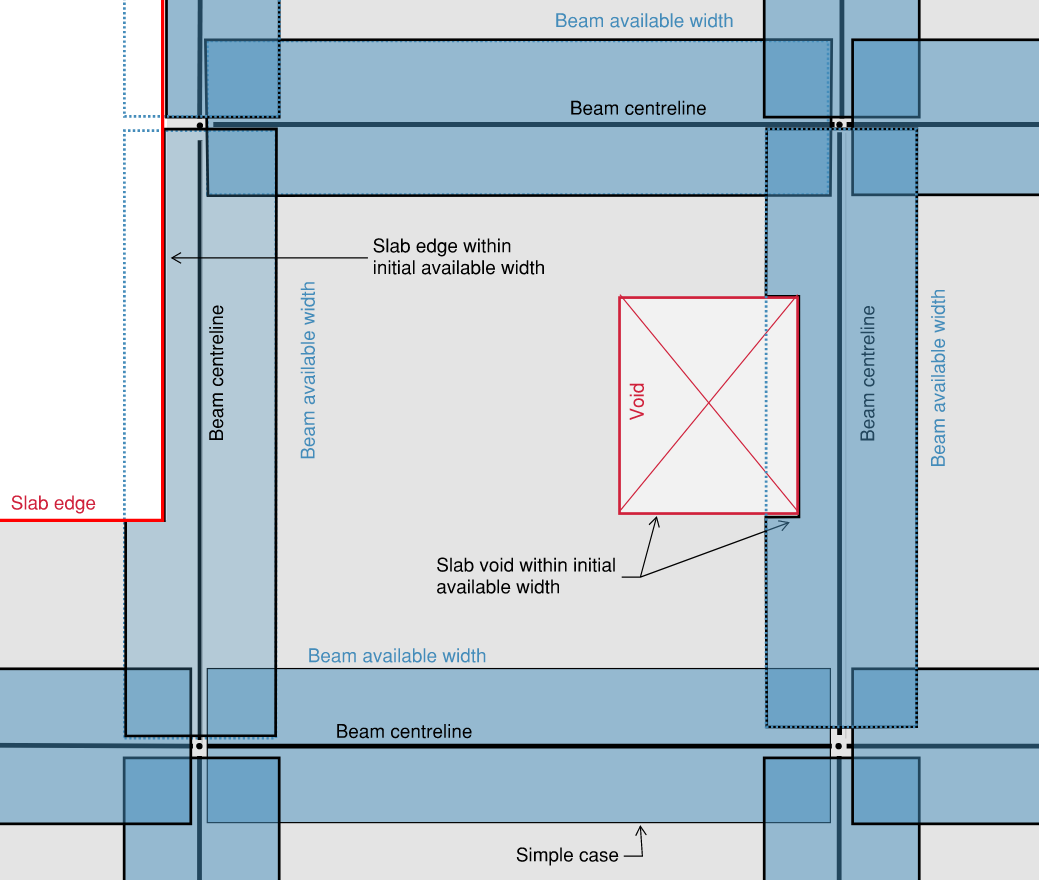
Where there are no restrictions from the slab geometry, the calculated available width on each side of a beam is one-eighth of its length (aligning with common code limits for maximum effective width). In most instances, this results in a rectangular available width.
That is, the total available width would typically be a quarter of the beam's length.
Slab geometry and voids
Where the available width for the simple base case clashes with a slab edge or a void, the area with no slab is removed from the calculation. And where a void would be within the estimated available width for the simple base case, this modifies the perimeter in such the area beyond the void is not available to the beam.
Presence of other beams
When multiple beams with overlapping base case available widths are present, reductions are applied at each side of the available width to account for the potential of increased demand on the shared area of the slab.
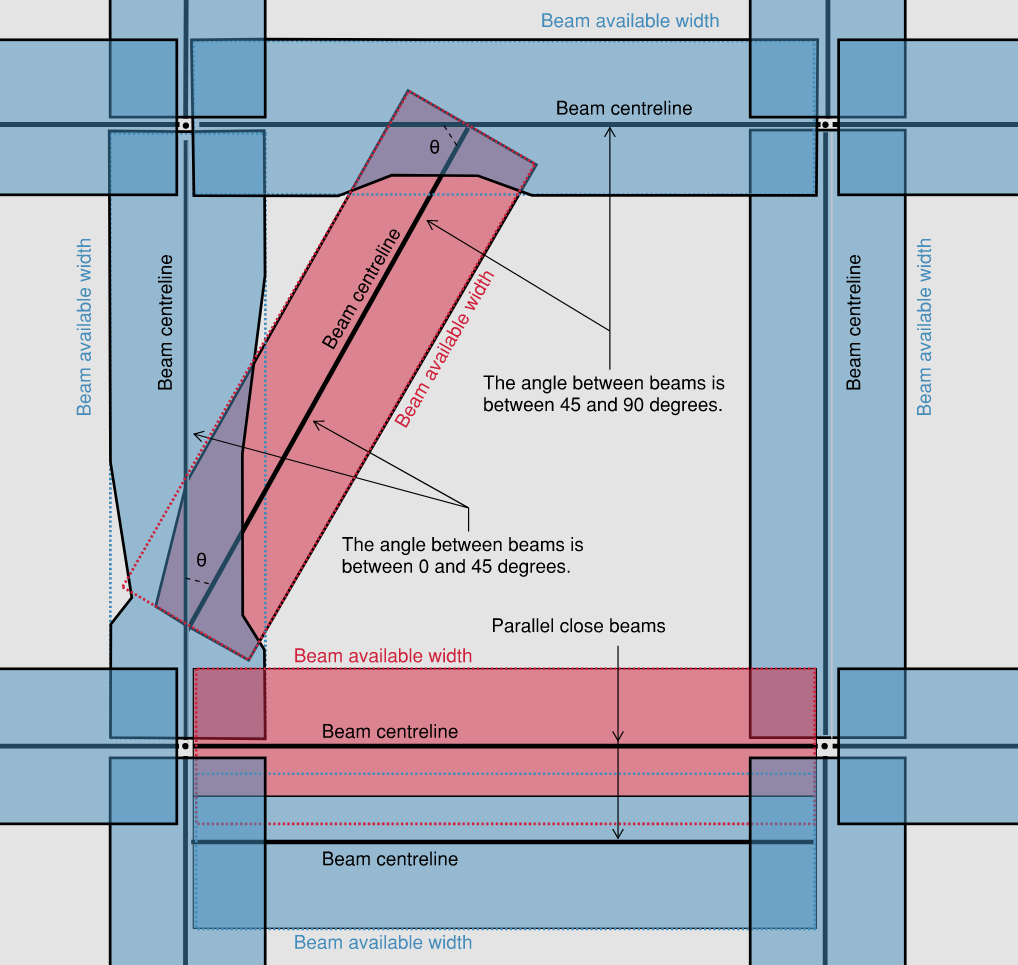
The rules followed to estimate these reductions, which are based on the angle between the beams , are described below.
Parallel close beams
The overlapping portion of available width is distributed equally between the two beams.
The beams are at low acute angles
The available width in the overlapping portion of slab is reduced by the factor:
And the portion of overlapping available width that crosses to the far side is reduced by:
The beams are at high acute angles
The available width in the overlapping portion of slab is reduced by the factor:
No reduction is produced on the far side. This is because the stress can only realistically radiate at an angle of 45 degrees.